
Lincoln County Projected Versus Actual Release
“Projected release date” is the common search phrase. Oregon Offender Search uses a more exact label: Earliest Release Date. Its definition treats the value as the earliest estimated date under current calculations. It may also display PENDING while a sentence is being calculated or Life where that term applies. None of those labels proves that release occurred.
A pretrial Lincoln County detainee has not yet received a final jail or prison term. A bail decision, conditional release order, dismissal, plea, trial result, detainer, or transfer can change the custody path. A sentenced person has a legal term, but staff still apply custody credit, eligibility rules, and later orders. The actual release date is the event later recorded by the jail, ODOC, or another responsible authority.
Find Lincoln County Projected Release Dates
Start with the last confirmed custodian. A county jail sentence, an ODOC prison term, and federal custody have separate records. The same person can move between them, so a date from one agency may describe only that phase.
- Check the Lincoln County current roster for present custody, Jail ID, SID, booking date, court, disposition, and any displayed Release Date.
- Read the court judgment. Decide whether the person is pretrial, serving a local jail sentence, or sentenced to ODOC.
- For a county sentence, ask Lincoln Jail Records how the calculated date is maintained and request Time Served Records after the event.
- For an ODOC sentence, search the Oregon Offender Search by SID when possible. Record Status, Location, Earliest Release Date, and Last Updated.
- Recheck after the estimate. Confirm the actual event with the later status and an official jail, ODOC, Board, or court record.
The Lincoln County released-inmate search provides the full path for identifying transfers and older exits. Do not use OOS as the default for someone whose case never left county jail.
Note: A Lincoln County roster disappearance can mean release, transfer, or a data change, so it does not settle the date.
Oregon Earned-Time Release Rules
For eligible felony prison terms based on crimes committed on or after November 1, 1989, ORS 421.121 allows a reduction tied to appropriate institutional behavior and adult basic-skills participation. The maximum reduction is 20 percent. Eligibility is not a promise of the maximum. Conduct, programming, sentence structure, administrative rules, and court action all affect the calculation.
The statute excludes several sentence categories, including terms governed by listed provisions in ORS Chapters 137 and 163. Oregon therefore has no safe rule that every person serves one fixed percentage. ODOC performs the calculation for an eligible prison term. A public search result should be quoted, not recomputed.
ODOC's official field is an estimate. The law and the sentence record control. An earned-time allowance can move an estimate earlier, but a pending calculation or unresolved judgment may delay a useful display.
View the source context in the official Oregon earned-time law.
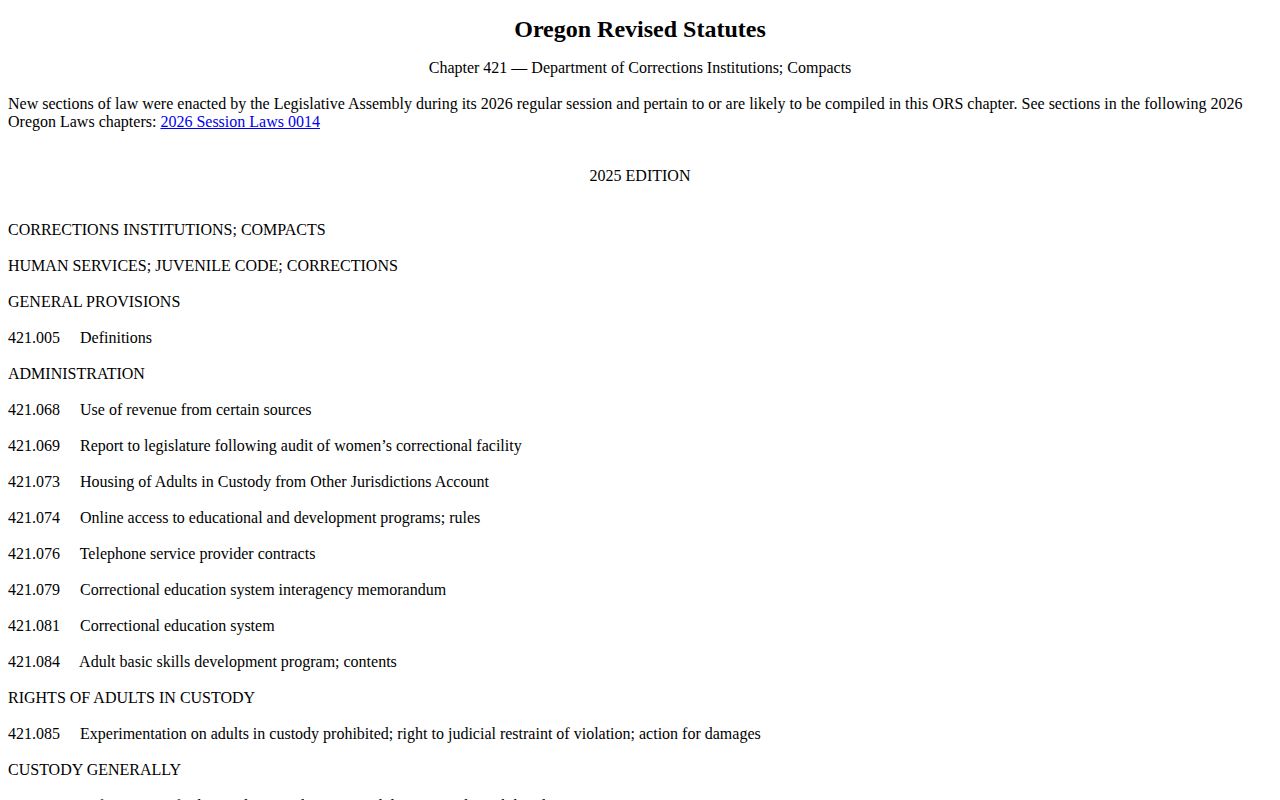
The statute image supports the limits on earned time; it is not a sentence calculator for an individual Lincoln County case.
Measure 11 Release Date Limits
Oregon Measure 11 is not a general rule that everyone serves 85 percent. Under ORS 137.700, the listed mandatory minimum must be served in full. Release to post-prison supervision, temporary leave, or a reduction under ORS 421.121 is not available during that minimum.
ORS 137.712 contains limited judicial exceptions for specified circumstances. It does not authorize a broad percentage shortcut. A sentence can also extend beyond the mandatory minimum. Read the judgment, offense statute, and any amended order. If the sentence calculation is disputed, obtain advice from counsel or the responsible agency rather than subtracting a percentage from the pronounced term.
Lincoln County Pretrial Release Dates
A pretrial detainee has no sentence-based release calculation. The court may set bail, order conditional release, change conditions, dismiss a charge, or hold the person while another matter proceeds. Lincoln County Pretrial Services develops realistic options for the court, including nonfinancial possibilities, but it does not publish a guaranteed date or processing time.
The Lincoln jail roster can display a Release Date while the person remains on the current-custody list. In that setting, the value is scheduled or calculated, not proof of an exit. Read Current Disposition, the next court event, and the case register. If a judge issues a release order, jail processing and any detainer still affect the physical event.
Bail can also change timing without producing a fixed public schedule. Lincoln's official bail information accepts exact cash or certified check payable to the Lincoln County Sheriff with the adult in custody's name in the memo. It gives no universal bond schedule or guaranteed release time. Use the jail and court for case-specific status, then obtain Time Served Records after release.
Lincoln County Release Date Changes
Release estimates respond to new facts and legal decisions. Some changes affect the arithmetic. Others change the agency that will hold the person next. A detainer, for example, is a request or authority for another agency to take custody. It may prevent a community release even when one sentence phase ends.
| Factor | Possible effect | Record to check |
|---|---|---|
| Earned-time eligibility or conduct | Credit may accrue, be limited, or be lost | ODOC calculation and ORS 421 |
| County worker credit | Eligible prospective credit may alter the local date | Jail calculation and handbook |
| Amended judgment or appeal | The legal term or custody credit may change | Court register and judgment |
| Consecutive or concurrent terms | Sentence structure changes total time | Judgment and agency computation |
| Board decision | A qualifying parole date may be set, deferred, or changed | Board Action Form or order |
| Detainer or transfer | One custody term may end without community release | Exit disposition and receiving-agency record |
Data can lag behind an order. Compare the displayed Last Updated time with the date of the judgment, Board action, or disciplinary decision.
Note: Quote the displayed date and update time instead of calculating a new estimate from partial facts.
Lincoln County Jail Worker Credit
County jail credit follows a different track from ODOC earned time. Lincoln County's in-custody handbook applies ORS 169.120 to eligible sentenced adult-in-custody worker time. Credit begins when qualifying work starts and can be applied prospectively to the calculated local date. It is not automatic for every booked person.
Removal from work, firing, or a conduct violation can cause loss of unearned work or good time and force staff to recalculate the date. A judicial order or law may make a person ineligible. Jail staff and the court control the calculation. The public roster's Release Date field does not reveal each credit component.
This local rule is why a county date should not be calculated with the state prison formula. It is also why a saved roster date can become stale. Request the later Time Served record for the actual admission and release interval.
Note: Eligible Lincoln County worker credit is prospective and conditional; it does not confirm that the person has left custody.
Lincoln County Parole Date Decisions
The Oregon Board of Parole and Post-Prison Supervision affects release timing only in cases within its authority. A Prison Term hearing may set a projected parole date or decline to set one. An Exit Interview may affirm or defer that date. Other hearing types can reduce a term, postpone release after serious misconduct, or decide a new custody period after revocation.
Most modern determinate sentences do not depend on a Board parole grant. Board jurisdiction includes defined older offenses, dangerous-offender sentences, and specified murder or youth-offender cases. Do not infer eligibility from age, charge name, or time served alone. Read the judgment and the applicable ORS Chapter 144 provisions.
The public hearing calendar is not a results database. Request the final Board Action Form or order when the Board controls the date. That record gives the outcome vocabulary and can show whether a projected date was set, affirmed, deferred, or postponed. Compare it with the current ODOC calculation before describing any date as active.
Confirm Lincoln County Actual Release
For a county jail case, request Time Served Records through the Lincoln County Sheriff's jail form. Include the full name, date of birth, SID or Jail ID if known, and a narrow booking and release date range. Ask for the actual exit date and time plus the disposition. The response can distinguish community release from transfer to ODOC or another authority.
For an ODOC case, return to OOS after the Earliest Release Date and read the status and location again. Request an ODOC custody or discharge record when formal proof matters. Board records are needed when a Board action set, deferred, or changed a qualifying parole event. VISOR can send a status alert, and the Lincoln County VINELink inmate search explains Oregon's current registration method.
Does a past date prove release? Not by itself. A past estimate with no matching status change may reflect lag, recalculation, or a move to another custodian. The later agency record supplies the actual outcome.
A Lincoln court judgment remains essential even after the person enters ODOC. It shows the sentence imposed, whether terms run together or one after another, and any award of presentence custody credit. ODOC then applies the sentence under its rules. If OOS and the judgment seem inconsistent, compare the update time and request the agency computation rather than choosing the earlier date.
Federal and immigration dates require other tools. A BOP result can show a federal release date, but the end of BOP custody does not rule out state or immigration custody. ICE's locator has a limited released-person window. Neither date should be merged with an Oregon Earliest Release Date, since each belongs to a different custodian and legal term.